Parry Sound

Boating Essentials, Starting January 2015

Parry Sound Power and Sail Squadron will be offering the Canadian Power Squadron course Boating Essentials starting in January 2015. Classes meet once a week at Canadore College, Wednesday evenings, from January 14th to March 11th, with no classes February 11th and 18th.

Cost of the course is $250 which includes instructional materials. Contact John Mason (705/342-1315) Commander Parry Sound Power & Sail Squadron, or Laurie Peddie (705.746.9222 ext. 7351) Canadore College, for more information.

Boating Essentials

Enjoyment and safety on the water require knowledge. Boating Essentials will take you to the next level in your boating education. Technology has changed the way we navigate. However, in order to use a GPS/chartplotter effectively, you should understand the use of paper charts and coastal navigation. The topics covered in this course; magnetic compass, global positioning and charts, navigation, conning, plotting, digital charting, anchoring, lines and ropes will increase your boating knowledge and make your adventures on the water safe and enjoyable.

The Stop

Are you ready for your OPP safety check on the water? Or, more importantly, are you prepared for an emergency?

A couple of weeks ago on a humid September day we had friends in town and decided to go for a cruise on Georgian Bay in our small power boat. Since it was calm we elected to circumnavigate Parry Island from Parry Sound harbour. While rounding Bears Head at the tip of Parry Island we were surprised to be flagged down by the OPP boat for a routine safety check. It was a pleasant encounter, all aboard my vessel were wearing inflatable PFD’s and since I am writing about it you might guess correctly that we successfully passed muster.

What struck me however, as I displayed the store bought kit with the mandatory items for my 17’ boat, was how wise in might be to routinely supplement the equipment on board. I had the mandatory paddle, but I also carry a substantial anchor and rode with chain, some extra lines (the stuff in the kit could pass for twine), a fire extinguisher, small air horn, flares, VHF radio, first aid kit, extra clothing, matches, compass (some items may be mandatory for your vessel – so check the regulations. I didn’t bore, or annoy, the officers by showing them my extra gear. But I was glad to know I had it onboard.

It is easy to be complacent out there – be prepared to help yourself and others.

RA – MAREP

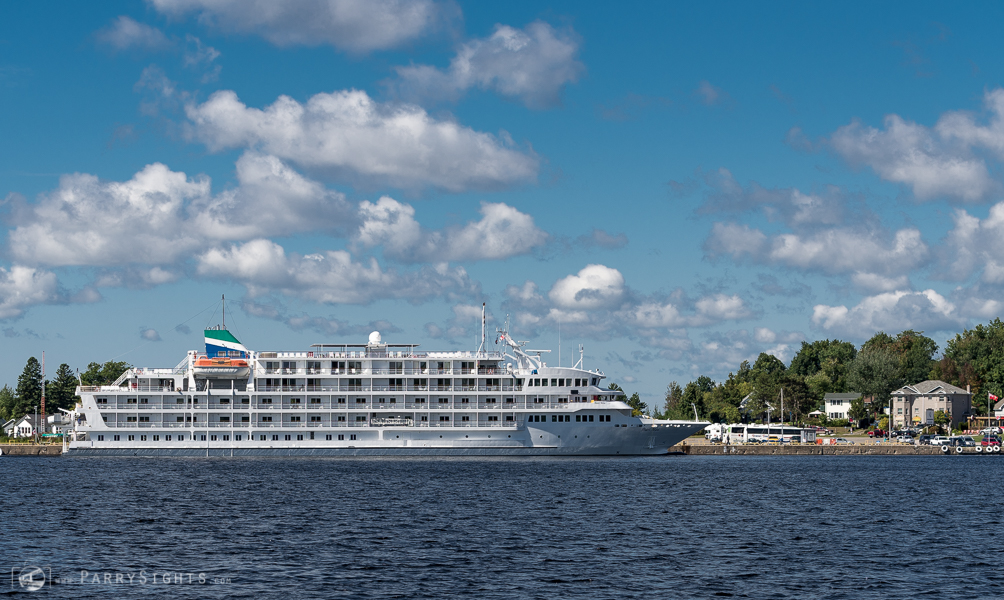
The Emerald Isle in Parry Sound. A candidate for a Parry Sound Power and Sail Squadron Courtesy Check?

ParrySights-1595

One Hand for the Boat. One for Yourself.

One hand for the boat; one for yourself. It’s a mantra repeated over and over by experienced boaters. Don’t let go of the boat. How many times I pointed out to Nat that he was standing in the dinghy with nothing in his hands; that he walked the length of the boat with little care to hold on.

Anchored in Regatta Bay, I was working down below while Nat learned to row the inflatable. I heard him come to the side of the boat, slide the oars into the cockpit, then little sound for a while until SPLASH!

By the time got my head outside he was swimming toward the boat. PFD holding him well out of the water; dinghy painter in his teeth, he was dog paddling – you couldn’t call it swimming – toward the boat.

After putting the oars into our boat he had planned to tie the dinghy to the boat. But he had let go and the wind had another idea. Now he was getting back to the boat the best he could.

We had another talk. But I think this experience might stick better. We will see.

Nathaniel Tows the Dinghy Home

PSPS - Nathaniel

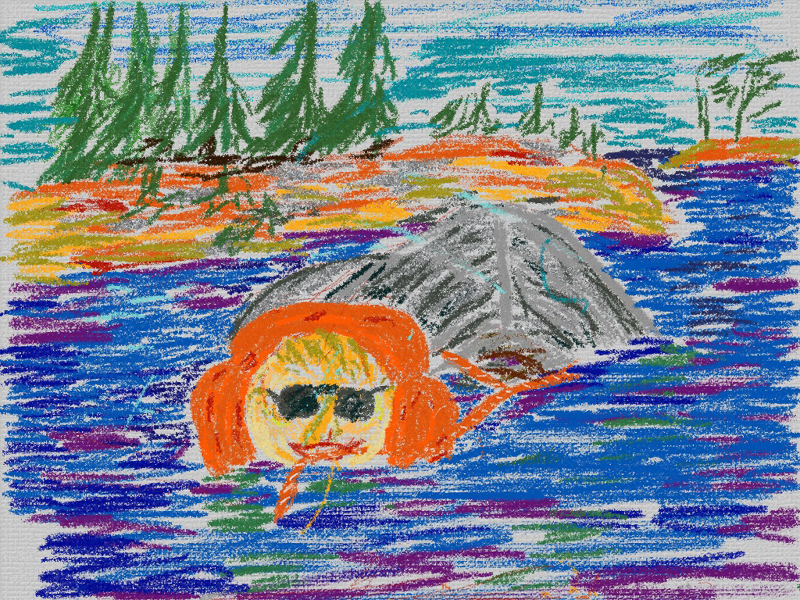
JM – Commander (iPad sketch using Art Set app)

Using Google Earth for Local Navigation

If you boat among the 30,000 Islands of Georgian Bay you are well aware of the many hidden rocks and shoals that seem to wait, daring you to come their way. A couple of days ago I saw a 40-foot power boat onshore with its bow ripped apart following an unadvised shortcut between channels. That’s life exploring the Georgian Bay Biosphere. Stay in the small craft route and you are guaranteed to have no surprises. Wander off the ‘beaten track’ into the more interesting areas and you take responsibility for what happens.

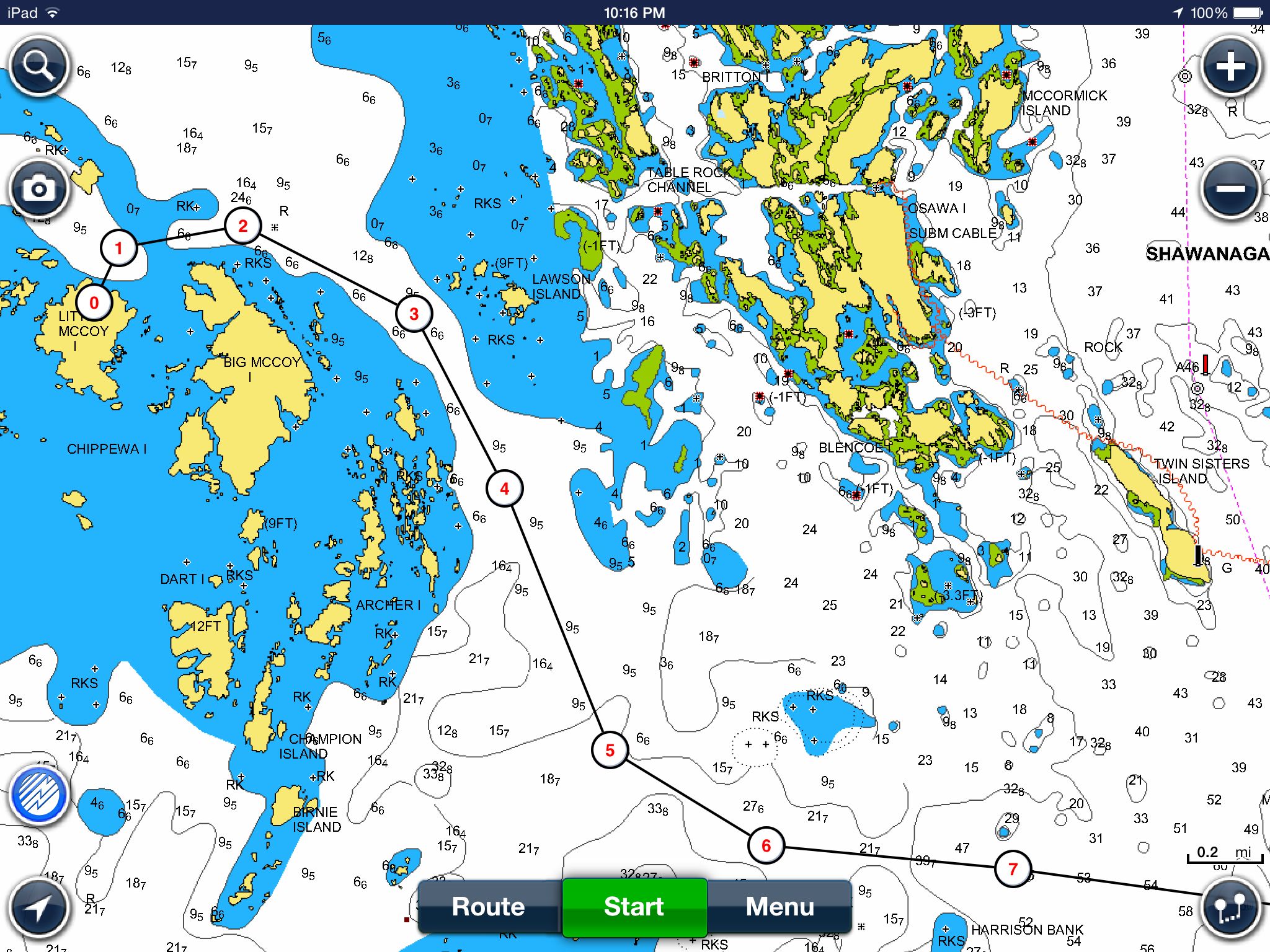
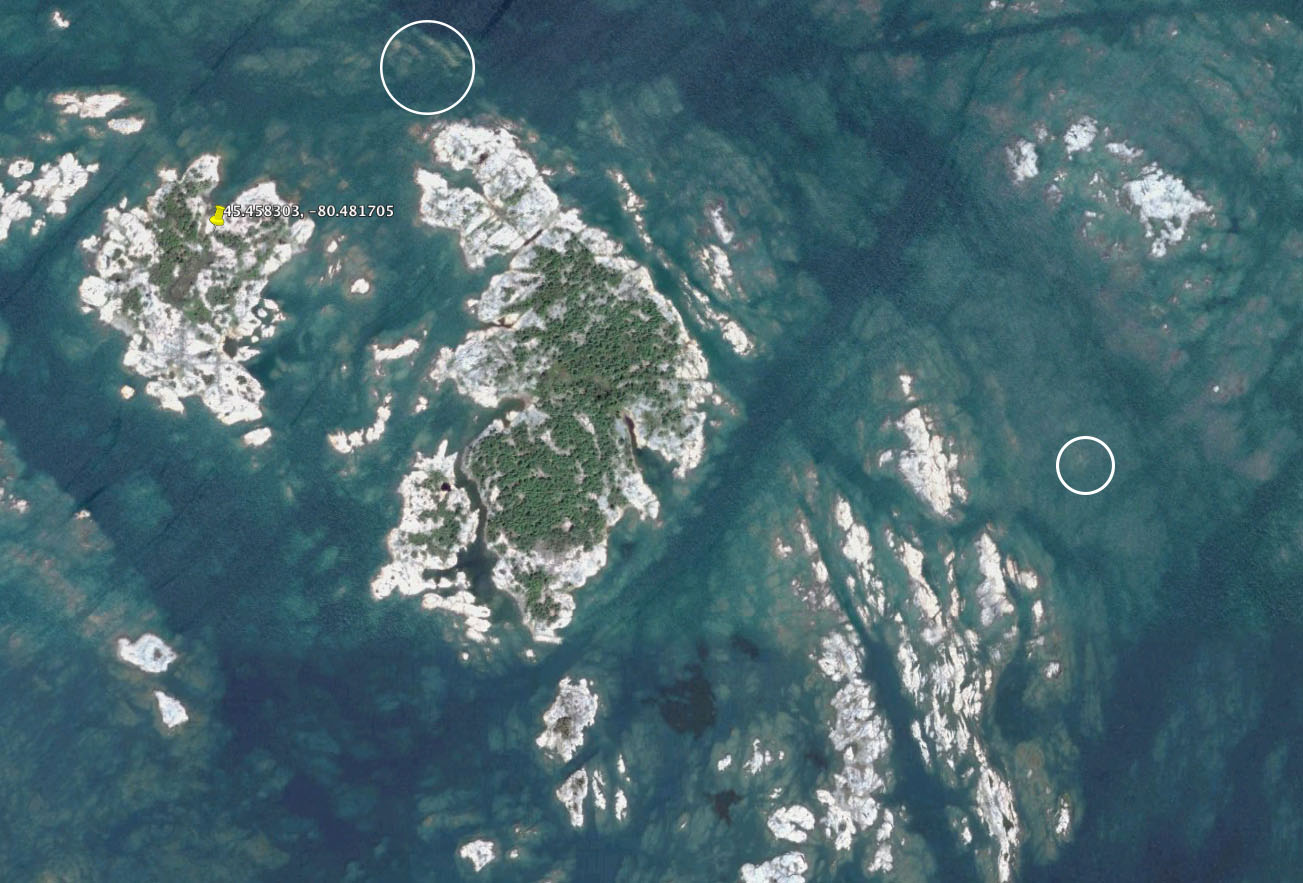
In a series of reviews last year I looked at how iPad apps from Navionics, iSailor and iNavX made it much easier to head off the small craft routes and explore some of the thirty thousand islands. Well these apps are great but they are not perfect as I found out last weekend on a trip from Parry Sound to Little McCoy Island (45.458303, -80.481705). This was a new destination for us and I spoke with couple of people about the best route to take as well as consulting with the Navionics and iSailor apps on my iPad. On route I was careful to ensure I stayed on my planned route using the Navionics app. Here’s a snapshot of the path once beyond the charted small craft route. The darker blue represents a depth of less than 6 feet while white represents depths of more than 6 feet. Boating with our 21-foot Scout and 150-hp Yamaha outboard I’m pretty comfortable with depths of 4-feet or more, and right now we are dealing with water levels at or slightly above chart datum.
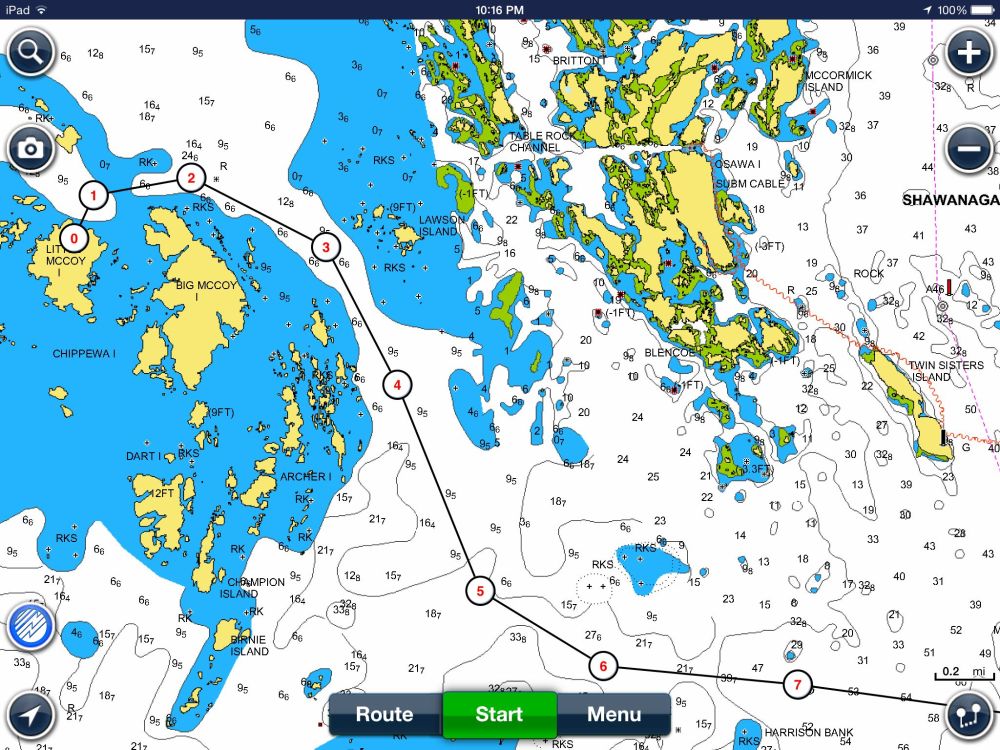
LittleMcCoy_v1Heading west of Franklin Island towards Little McCoy.

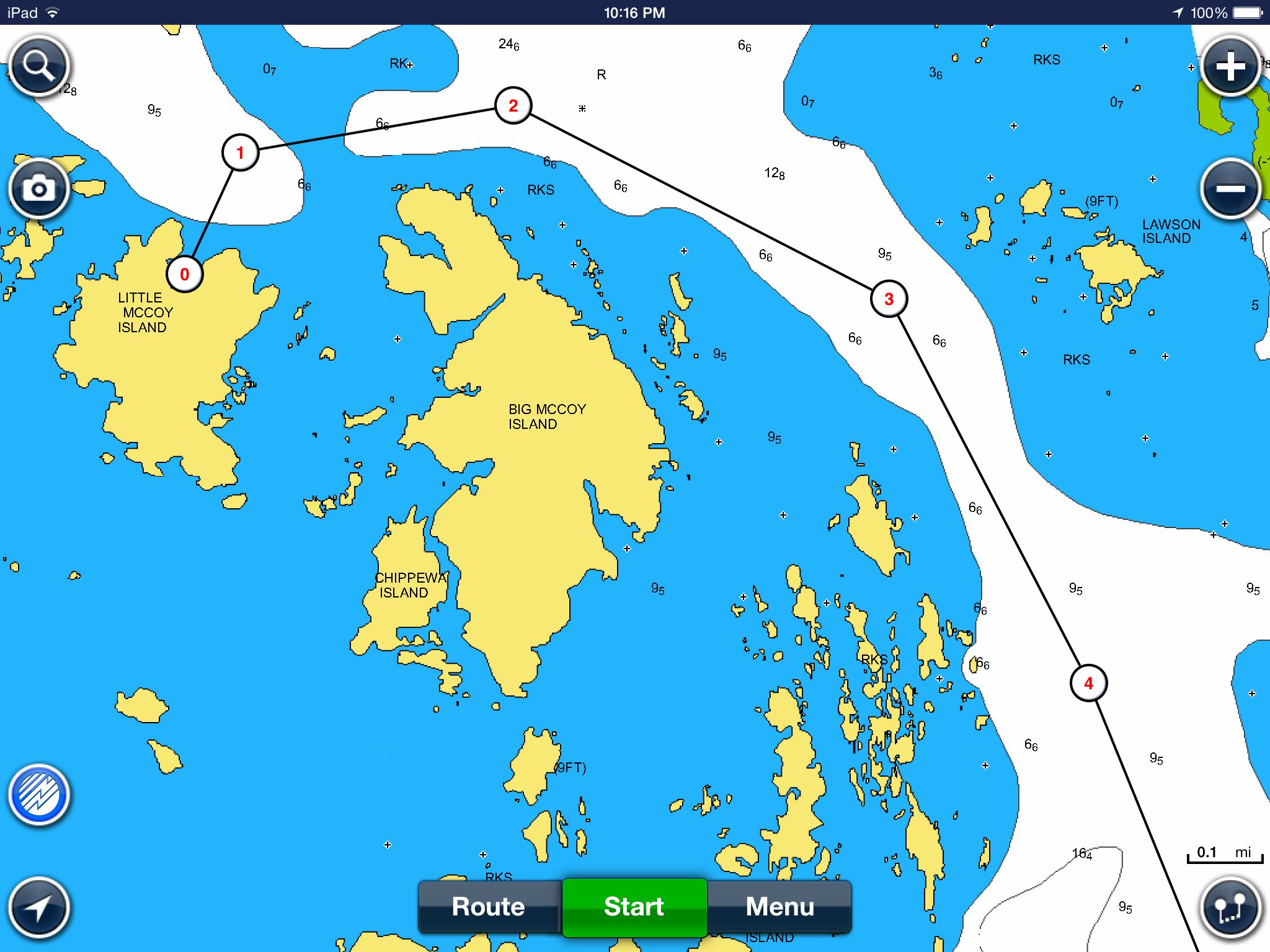
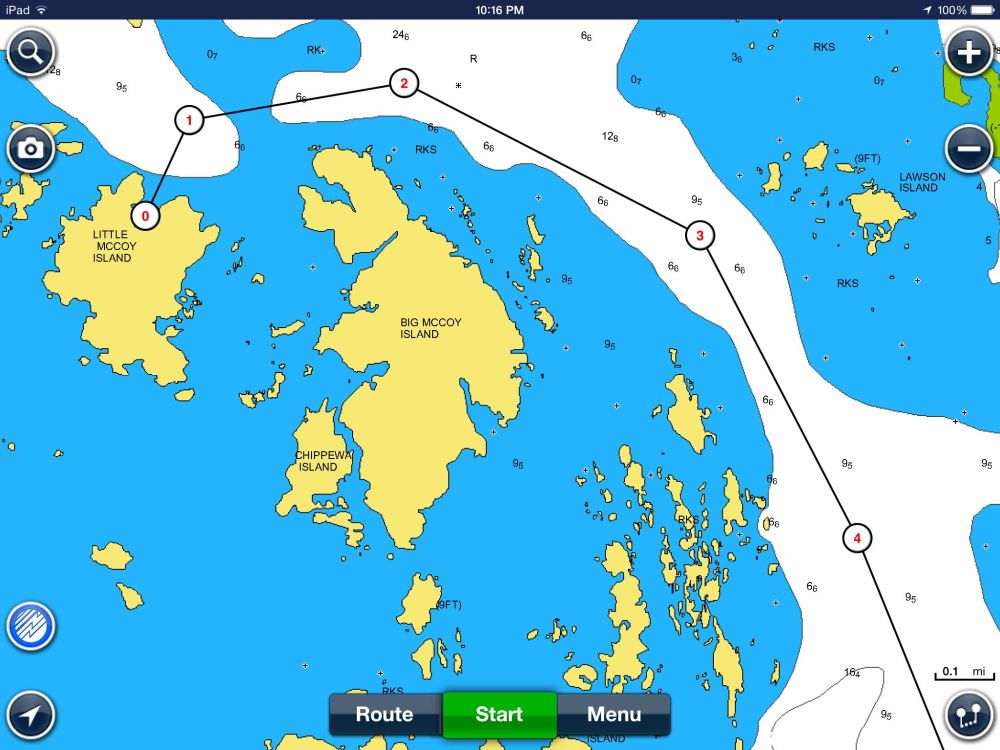
Here’s a closer look as you approach the McCoy’s. It’s pretty obvious that there is a safe seam running east of the McCoy Islands with issues just as you approach Little McCoy Island. Or so you would think.
LittleMcCoy_v2

On the way in I managed to ding the prop, not too seriously, about where you see the Number 2 on the Navionics chart. (Click image for a larger view.) On the way back I suffered a separate ding, at higher speed, between points 3 and 4. According to the charts I was in an area that should have had more than 6-feet of water. In particular the ding beyond point 3 (heading south) was a surprise, as evidenced by the fact that I was confidently moving at about 40 kph (25 mph) – ouch, ouch, ouch. There had been no problem on the way in and I was pretty much on the same track. (That’s another nice feature of Navionics and iSailor, you are able to lay down a track that you can follow when returning.)

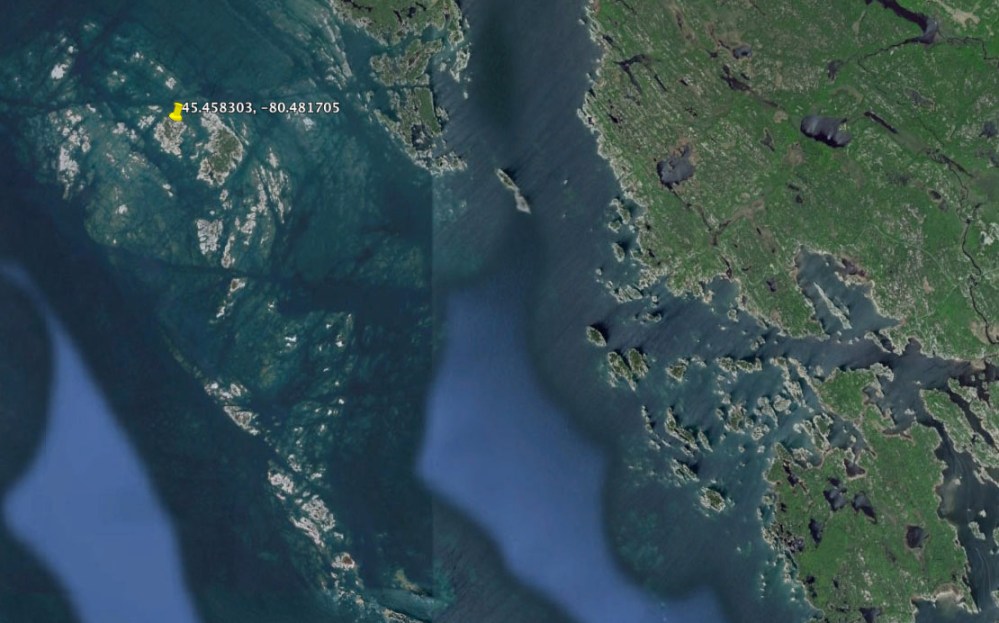
Now about Google Earth. In this part of the world Google Earth and Google maps have on and off coverage, here’s an example of the area around Franklin Island and the McCoys. In those areas where there is a stretch of open water they generally choose to blur out the area with a not very aqua blue. (Hey it’s just water what else is there to show?)
Google_Earth_Franklin-McCoys

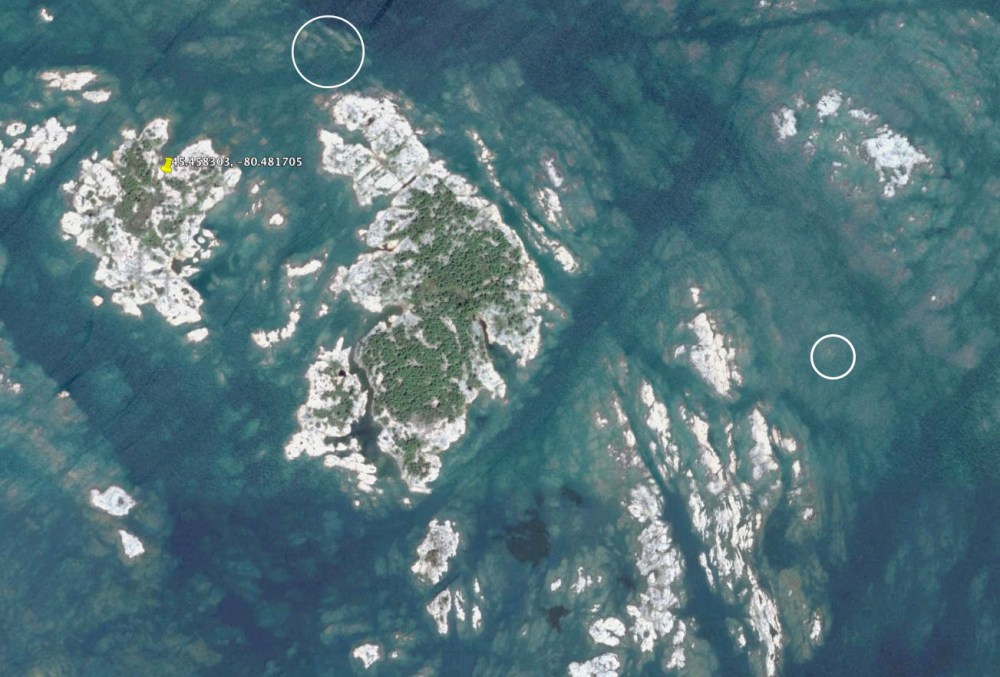
Looking closer (below), Google Earth can explain what I ‘discovered’ on my way in and out of Little McCoy. It’s pretty obvious that there is a seam in the channel that is consistent with the Navionics charts. But they are not perfect seams as you can see looking a little closer. I’ve tried to approximate the ‘ding points’ on the Google Earth projection and you can see what I discovered with the bottom of my outboard. What Navionics didn’t catch were the several shallow points in the area identified as 6-feet or deeper. No criticism of the app, they can’t be expected to have information on every square foot of Georgian Bay.
Google_Earth_McCoys_Ding_Points

What is interesting is the area north of Big McCoy Island (below). Contrary to what is indicated by Navionics it seems the safer route is closer, not further away, from the island.
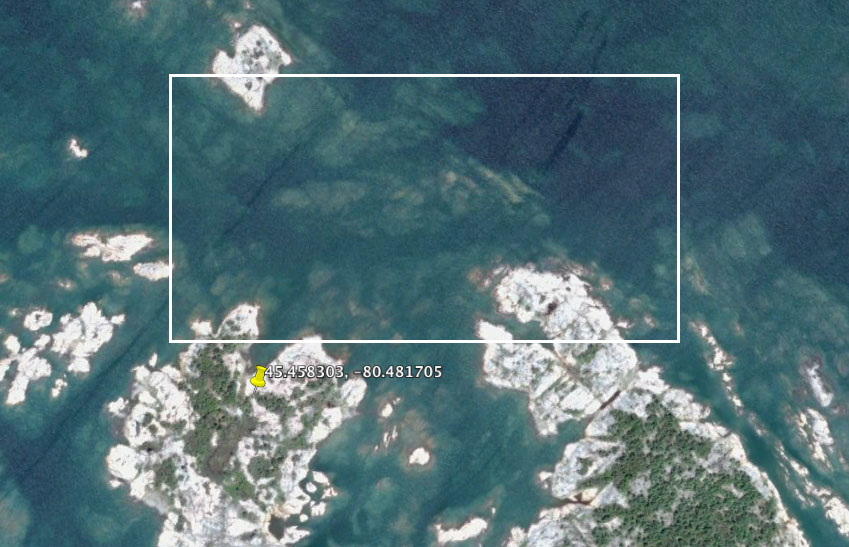
Google_Earth_McCoys_North

Lesson learned and a look at Google Earth will be part of my standard operating procedure when wandering too far off the well charted areas. Actually I will  pay better attention to the Google Earth information and plot some of the more challenging points on the Navionics charts. The irony is that I did look at the Google Earth maps before heading out but failed to look close enough and map it against the Navionics chart data.

Google Earth and Navionics seem to be a natural fit and worth exploring before heading out. Whatever type of ding the prop and skeg took it didn’t impact performance on the way back, but I haven’t yet had the courage to tilt the engine forward and take a look.

JB – Communications Officer
 

Geocache Placed – Winnett Island

Parry Sound Power and Sail Squadron’s seventh GeoBayCache has been placed and confirmed on Winnett Island. It’s officially Cache #5.

The cache coordinates are:
45.178171º
-80.098477º

This is the same as:

45°10.6903′
-080°05.9086′

Depending on whether you are using a Degrees or Degrees/Minutes format.

This is an easier cache to access from the government docks at Winnett Island, there seems to be lots of deep water. The cache itself is less than a couple hundred meters away from the dock area. As you are well aware GPS coordinates are at best ‘close’, for a variety of reasons they may be +/- up to ten meters ‘off’. So be sure to look around for the cache in the general area of the coordinates. To make things a little easier a couple of photos are posted below that can help you locate the cache. Please post up a note on our Facebook page, or a comment on this site, when you locate one of the caches. Let us know if the cache is missing (it shouldn’t be too hard to find), or it is damaged or missing any items (notepad, pencil/pen, cache cards).

Cache on Winnett Island

IMG_1243 IMG_1242

Geocache Placed – Wreck Island

Parry Sound Power and Sail Squadron’s sixth GeoBayCache has been placed and confirmed on Wreck Island in the Massasauga Provincial Park. It’s officially Cache #2.

The cache coordinates are:
45.139549º
-080.107821º

This is the same as:
45º 08.373′
-080º 05.909′

Depending on whether you are using a Degrees or Degrees/Minutes format.

This is an easier cache to access from the government docks at Wreck Island. The cache itself is less than a hundred meters away from the picnic area. As you are well aware GPS coordinates are at best ‘close’, for a variety of reasons they may be +/- up to ten meters ‘off’. So be sure to look around for the cache in the general area of the coordinates. To make things a little easier a couple of photos are posted below that can help you locate the cache. Please post up a note on our Facebook page, or a comment on this site, when you locate one of the caches.

The Cache on Wreck Island

IMG_1240 IMG_1239

Geocache Placed – Windsor Island

Parry Sound Power and Sail Squadron’s fifth GeoBayCache has been placed and confirmed on Windsor Island, on the southwest of Franklin Island. It’s officially Cache #6.

The cache coordinates are:
45.38033º
-080.34578º

This is the same as:
45º 22.820′
-080º 20.747′

Depending on whether you are using a Degrees or Degrees/Minutes format.

This is a trickier cache to access as there is no government dock. It will mean pulling up to the shore or anchoring out and using a dinghy to get to shore. It has been suggested that the best approach is from the east in an area that is referred to as Windsor Island Harbour. On some charts an anchorage is shown that is close to where the cache can be found.

Geocache Placed – The Pancakes

Parry Sound Power and Sail Squadron’s fourth GeoBayCache has been placed and confirmed on The Pancakes, an island a couple of kilometres south of Snug Harbour. (Our Commander managed to place this one and a couple others last weekend and I’m just getting around to posting them up.) It’s officially Cache #9.

The cache coordinates are:
45.34040º
-080.29472º

This is the same as:
45º 20.424′
-080º 17.683′

Depending on whether you are using a Degrees or Degrees/Minutes format.

There is a government dock on The Pancakes, but it can fill up so be prepared to circle back in an hour if you don’t want to anchor and ‘dinghy’ in to shore. The water is high enough that access to the dock is much easier than in previous years. The island itself is quite flat, ergo the name, and quite easy to get around and explore. It also offers some crude but quite usable bathroom facilities.

As always (You are a Power Squadron graduate aren’t you?) be careful on the water and on the islands. You may come across poison ivy and the protected Eastern Massasauga Rattlesnake. Neither should be a concern if you keep your eyes and ears open and your hands to yourself.

Check out information at the Parry Sound Power and Sail Squadron GeoBayCaching page for information on the Squadron’s geocaching program.

Geocache Placed – Regatta Bay (Franklin Island)

Parry Sound Power and Sail Squadron’s third GeoBayCache has been placed and confirmed in the Regatta Bay area on Franklin Island. It’s officially Cache #3.

The cache coordinates are:
45.38583º
-080.33467º

This is the same as:
45º 23.150′
-080º 20.080′

Depending on whether you are using a Degrees or Degrees/Minutes format.

There is no government dock in Regatta Bay so you will need to anchor or pull up on shore to find the cache. Wet feet are a possibility. Come August you should find Cardinal flowers marking the general area. The cache itself is not really hidden. The idea of the program is to provide boaters with an opportunity to explore new spots in the Georgian Bay Biosphere.

There seems to be lots of water this year, so there shouldn’t be too many surprises if you follow the charted routes. But be careful on the water and on the islands, you are likely to come across poison ivy and the protected Eastern Massasauga Rattlesnake. Neither should be a concern if you keep your eyes and ears open and your hands to yourself.

Check out information at the Parry Sound Power and Sail Squadron GeoBayCaching page for information on the Squadron’s geocaching program.